


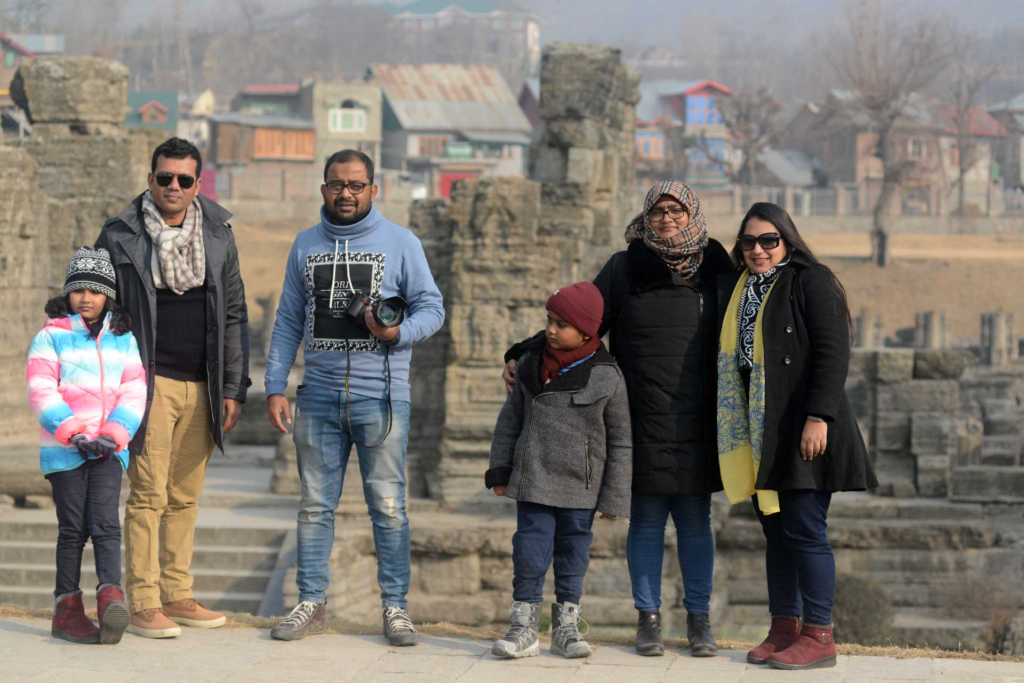
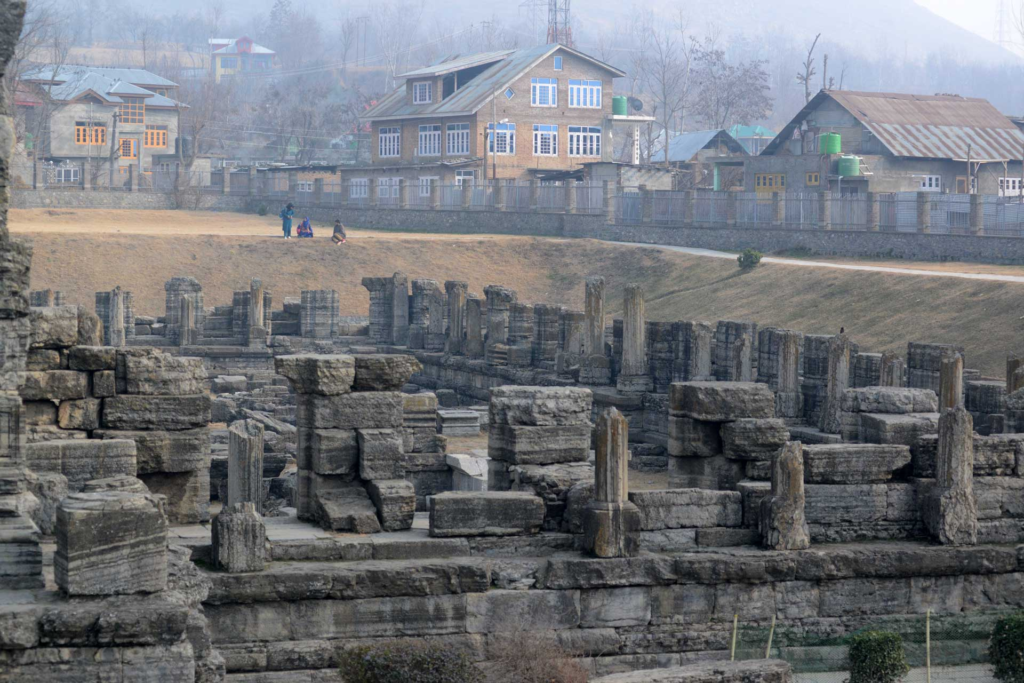
We visited Avantipora in December 2018, on a cold, hazy morning somewhere on the road between Srinagar and Pahalgam. Winter had already stripped the trees bare, and a thin mist sat low over the valley — the kind of light that makes old stone look even older. About 28 kilometres southeast of Srinagar, on the banks of the Jhelum, a scatter of grey limestone pillars rose out of an open field. A few other visitors were wandering the ruins that morning too, bundled up against the cold, giving us a quiet sense of scale against the massive broken columns. Modern houses with tin roofs crowded the horizon just beyond the boundary wall. At first glance, you might mistake it for just another archaeological curiosity marked on a tourist map. But these broken columns are the remains of one of the most ambitious building projects in Kashmir’s history — the twin temples of Avantipora.
A King Who Built From the Ashes of War
To understand Avantipora, you have to understand the man who built it. King Avantivarman came to power in 855 CE, inheriting a Kashmir that had spent nearly four decades exhausted by civil war and famine. He was the grandson of Utpala, one of five brothers who had wrested control from the old Karkota dynasty, and he founded a new line of kings — the Utpala dynasty — that would go on to define this era of Kashmiri history.
What set Avantivarman apart wasn’t just political survival. It was what he did once he had power. He appointed an engineer named Suyya as his prime minister, who is credited with reworking the Jhelum’s flood-prone course and turning famine-struck land into fertile farmland. With prosperity came peace, and with peace came an extraordinary flourishing of art, architecture, and Sanskrit learning. Kashmir, under Avantivarman, became a place scholars and artisans travelled to, not away from.
He marked this new capital — then called Vishwasara, later renamed Avantipora after him — with two temples that would announce his reign to history.
Time destroys all things, but the memory of the noble endures.
Two Temples, Two Gods, One Statement
The smaller of the two, the Avantiswami Temple, was built before Avantivarman even took the throne, and dedicated to Lord Vishnu. The larger one, the Avantishwara Temple, came after his coronation and was dedicated to Lord Shiva. Historians point out that this wasn’t accidental — by honouring both principal deities of Hinduism, Avantivarman was making a deliberate statement about religious harmony in a valley that has always held multiple spiritual traditions close together.
Both temples followed the same essential plan: a shrine set in the middle of a large rectangular courtyard, enclosed by stone walls and lined with a colonnade of fluted pillars. Walking among the ruins that morning, you could still trace this geometry in the foundations — rows of stone stumps marking where columns once stood, doorframes carved with trefoil niches, and fragments of relief work that hint at the intricacy the temples once had.
The stone itself tells its own story. Kashmiri temple builders of this period favoured a distinct grey limestone, worked into thick, precisely joined blocks that have survived over a thousand years of earthquakes, invasions, and neglect — even in the broken state we found them in.
The Long Fall
Avantivarman died in 883 CE, and the peace he built didn’t outlive him for long. His descendants fell into their own civil war, and Avantipora’s fortunes declined with the dynasty’s. Later Kashmiri rulers were not kind to the temples: in the 11th century, King Kalasha is recorded as having confiscated the villages whose revenues funded the temple’s upkeep. In the 12th century, the site was repurposed as a military base during local conflicts. And in the 14th century, Sultan Sikandar — remembered in Kashmiri history as “But-shikan,” the idol-breaker — is associated with further destruction of the temples, part of a broader wave of damage to Kashmir’s Hindu monuments during that period.
By then, Avantipora as a capital had already faded from memory. Earthquakes did what human hands hadn’t finished, and the temples slowly sank beneath centuries of silt and soil. Locals came to call the mounds “Pandav Lari” — the house of the Pandavas — folding the ruins into legend rather than remembering the king who actually built them.
It wasn’t until the early 20th century that archaeologist Daya Ram Sahni carried out systematic excavations, uncovering the temple plans that visitors can walk through today. The Archaeological Survey of India now protects the site.
Our Visit, on a Winter Morning
What struck us most on arrival was the contrast: broken 9th-century masonry in the foreground, and ordinary Kashmiri village life — tin-roofed houses, laundry lines, satellite dishes — going on just behind the boundary fence. Avantipora isn’t sealed off behind glass in a museum; it sits right at the edge of everyday life, the way ruins often do in places with a very long, continuous history.
December turned out to be a beautiful, if bitterly cold, time to visit. The bare winter trees and the soft, diffused light made the stone textures stand out in a way I don’t think harsher summer sun would have allowed. We took our time — looking closely at the pillar bases for surviving relief carving, noticing how the stone courses shifted colour and texture where later repairs or collapses had happened, and just taking in the setting: the Jhelum nearby, the hills turning hazy in the distance, the quiet broken only by the occasional other visitor picking their way across the stones.
Getting there: Avantipora lies on the main Srinagar–Jammu highway, roughly 28–30 km from Srinagar, making it an easy stop for anyone travelling toward Pahalgam or further south into the valley. We reached it by road in under an hour; a taxi or local bus from Srinagar will get you there just as easily.
Why It’s Worth the Stop
It’s easy to drive past Avantipora on the way to somewhere more famous — Pahalgam’s meadows, Srinagar’s houseboats, Gulmarg’s slopes. We nearly did too. But these ruins are a physical record of a Kashmir that doesn’t often make it into the postcard version of the valley: a Kashmir that was, for a few decades in the 9th century, one of the great centres of learning, architecture, and religious pluralism in the subcontinent. Standing among the columns on that cold December morning, it wasn’t hard to imagine what Avantivarman was trying to build — not just a temple, but a legacy. Much of it didn’t survive. But enough remains to tell the story, if you know where to look — and if you’re willing to stop the car.

